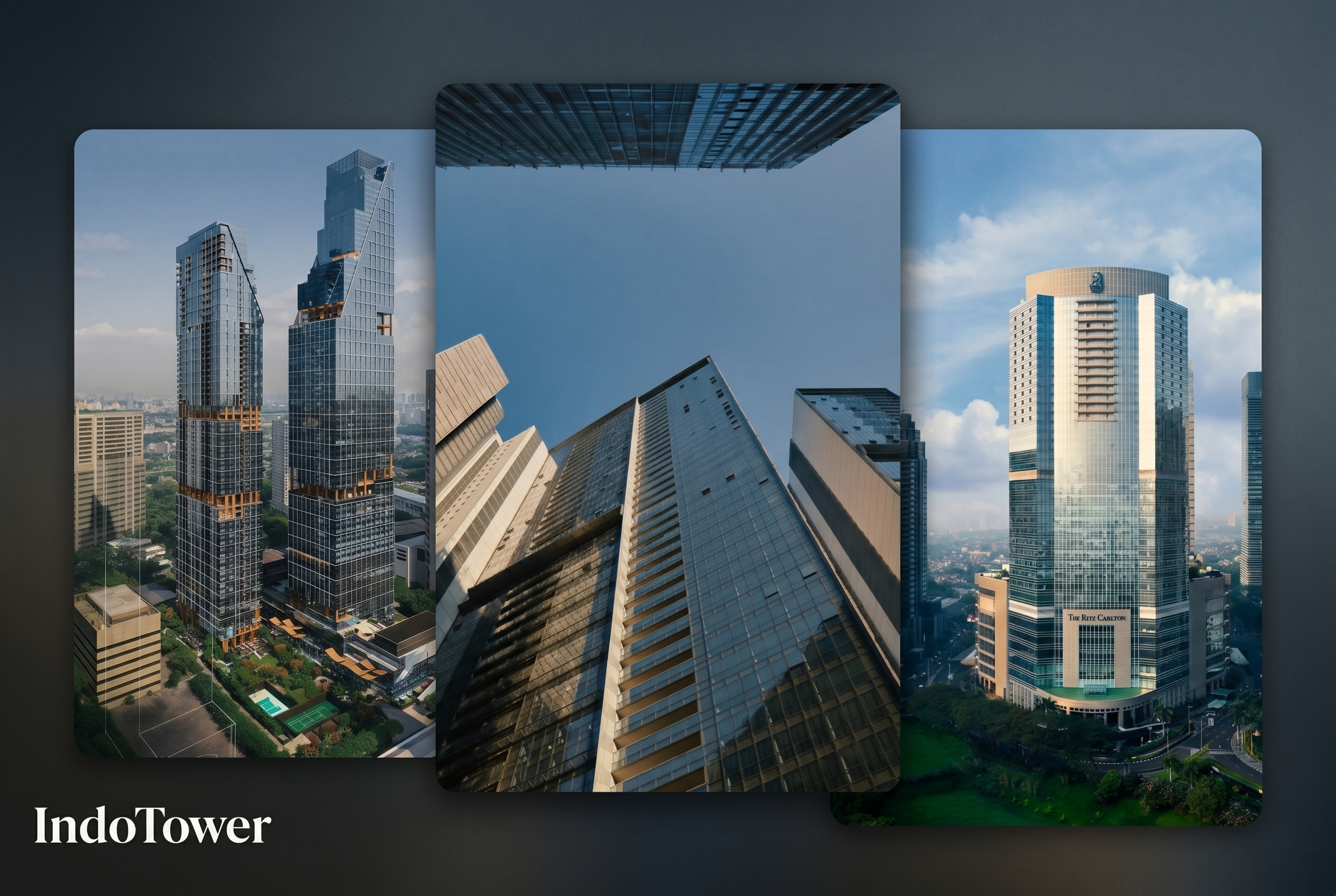
There is a building site at Jalan MH Thamrin No. 13, Jakarta Pusat, sandwiched between The Plaza, Kempinski Hotel, UOB Plaza, and Menara BCA — perhaps the most valuable strip of real estate in all of Indonesia. On that site, two supertall towers have been rising since 2015, their steel frames now punching above the Jakarta skyline at 303 and 306 meters respectively.
Indonesia 1 Tower, as it is formally known, comprises twin mixed-use towers on a 33,000-square-meter site in Central Jakarta, with a combined floor area of 204,000 square meters across 65 and 60 floors. Total development cost: approximately Rp 8 trillion. Structurally topped-out as of early 2026, with completion now targeted for 2027 — it will rank among the tallest buildings ever constructed in Indonesia. WikipediaKeuangan News
The project should have been finished in 2020. Then 2021. Then 2023. The reason it wasn't is one of the most dramatic corporate breakdowns in Indonesian property history — and the reason it is finally nearing completion is a story about a media conglomerate that refused to walk away.
The Man Who Bet on the Sky
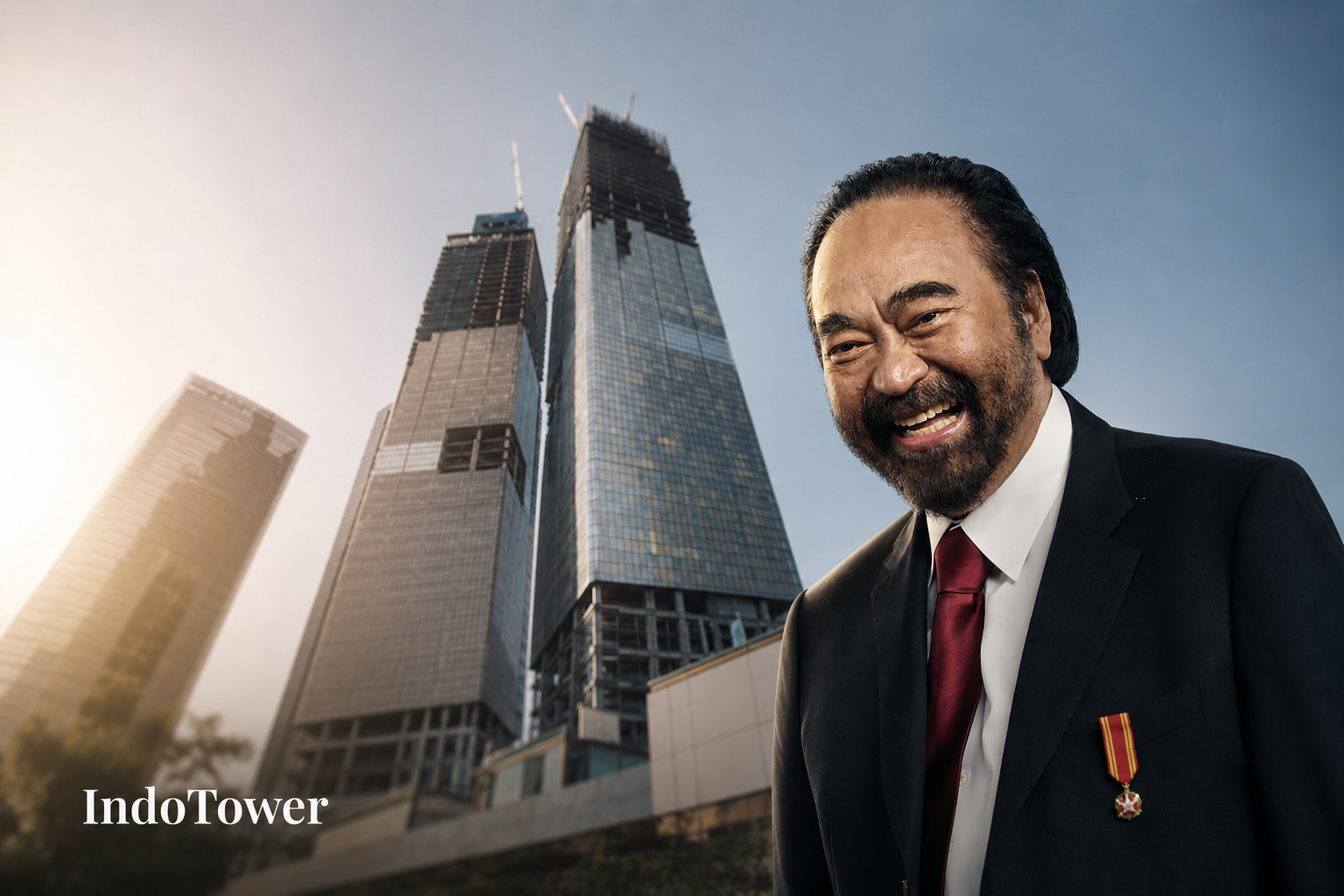
Surya Paloh is not, at first glance, a property developer. He is Indonesia's most prominent media proprietor — founder of Metro TV, owner of the Media Indonesia newspaper, chairman of the NasDem party, and one of the most politically influential private citizens in the country. Forbes listed him among Indonesia's 100 wealthiest individuals with total assets of US$440 million as of 2021. Katadata
But Paloh's empire has always been broader than his public identity suggests. Media Group's portfolio spans news, food industry and catering services through PT Indocater, hospitality through properties including Intercontinental Bali Resort, The Papandayan Bandung, and The Media Hotel & Towers, plus investment holdings in marble, gold, and oil and gas through PT Surya Energi Raya. Olenka
Indonesia 1 was conceived as the physical crown of that empire — a statement tower in the heart of Jakarta's CBD that would announce Media Group as a force in commercial real estate. Groundbreaking was held in 2015, presided over by President Joko Widodo himself. The project was structured as a joint venture through PT China Sonangol Media Investment (CSMI), combining Paloh's PT Media Property Indonesia (MPI) with China Sonangol Real Estate (CSRE), a Singaporean entity backed by Chinese capital.
For several years, the arrangement held. By 2019, both towers had reached floor 48. Completion was announced for Q4 2020.
Then everything broke.
When the Partner Walked
The internal collapse of CSMI is a cautionary tale about cross-border joint ventures in high-stakes property. MPI alleged that CSRE violated its commitment to deliver a 30% equity stake to the Indonesian side — and when leadership at CSRE changed, many agreed commitments were unilaterally revised. Construction slowed. Debts to the contractor — PT ACSET Indonusa (ACST) — went unpaid. The project that Jakarta's president had blessed at groundbreaking was quietly stalling above the city's rooftops. Kumparan
MPI escalated aggressively. The company reported CSMI to the Jakarta Metropolitan Police on allegations of investment fraud and embezzlement. Physical control was asserted on-site. Lawyers were retained on both sides. CSRE hired prominent attorney Otto Hasibuan as legal counsel and held its own press conference denying all allegations. For months, one of Jakarta's most visible construction sites became the stage for a corporate war waged across boardrooms, courtrooms, and press conferences simultaneously. KompasKumparan
The resolution came in December 2021. MPI completed the acquisition of 100% of CSMI's shares, taking full ownership of Indonesia 1 and renaming the vehicle PT Surya Indonesia 1 Properti — "Surya" drawn from its founder's own name. DetikFinance
The Long Road Back
Taking control of a half-built supertall skyscraper mid-dispute is not a simple task. MPI had not fully settled its outstanding debt to ACSET Indonusa, the construction contractor, at the time of acquisition. The building was approximately 60% complete. Roughly 40% of the work — and the most complex structural and fit-out phases — still lay ahead. Kompas
Paloh's team spent the first months of 2022 in financial reconciliation, clearing the path to restart full construction. Targets shifted repeatedly: end of 2023, then 2024, then beyond. Each delay reflected not just the scale of the construction challenge but the complexity of re-mobilizing an international-grade project after years of disruption.
As of early 2026, Indonesia 1 Tower is structurally topped-out — both towers have reached their full structural height — with final completion now scheduled for 2027. Wikipedia
What the Towers Will Become
Indonesia 1's North Tower will house offices from floors 4 to 44, with floor plates ranging from 1,685 to 1,830 square meters, and serviced apartments from floors 47 to 57 including studio units. The South Tower completes the mixed-use stack with additional commercial and residential space. The complex sits directly connected to Jakarta's MRT network below ground — among the first CBD developments in the city with direct underground rail access. Bisnis
The address alone is extraordinary. Flanked by The Plaza, Kempinski Indonesia Hotel and Residences, and Menara BCA, Indonesia 1 occupies what may be the single most coveted corner of Jakarta's central business district. When fully tenanted, it will compete directly with the capital's highest-grade office and residential towers — in a market where premium supply remains structurally constrained.
The Bigger Picture
Indonesia 1 is more than one man's vanity project or one company's balance sheet entry. It is a case study in the resilience — and the risks — of large-scale property development in Indonesia's political economy.
Surya Paloh launched this tower with a presidential endorsement and a Chinese capital partner. He lost the partner, navigated criminal allegations, paid off contractor debts, and rebuilt the financing structure from the ground up. Through it all, the steel kept rising — floor by floor, through pandemic and legal crisis alike.
By 2027, when the towers open to tenants, most Jakartans will simply see two new supertalls on the Thamrin skyline. The IndoTower readership should know the decade it took to put them there.